
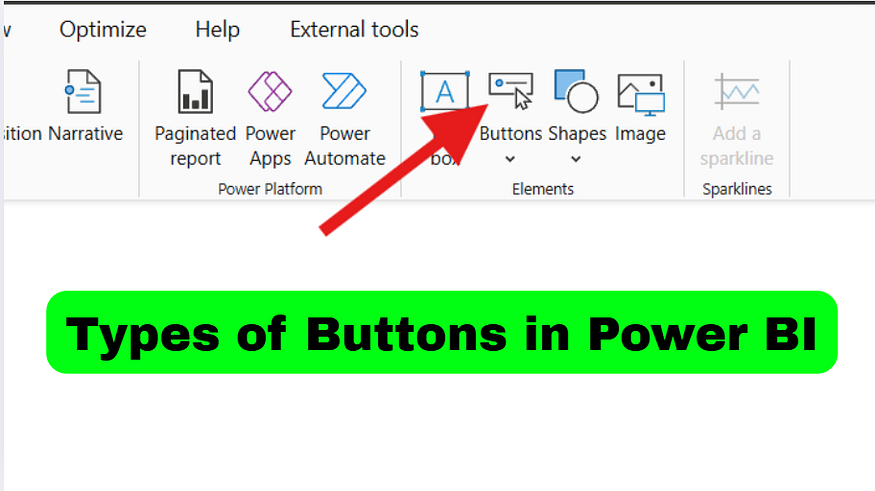
Types of Buttons in Power BI


Types of Buttons in Power BI


1. Blank Button

  • Just a basic button — you can fully customize it.
  • Add your own text, icons, images, and actions.
  • Perfect when you want total creative control.

2. Back Button

  • Takes the user back to the previous page.
  • Commonly used with bookmarks or drillthrough pages.
  • Great for improving navigation in multi-page reports.

3. Bookmark Navigator Button

  • Automates navigating between bookmarks.
  • You can create different “views” (like tabs) and link them easily.

4. Page Navigator Button

  • Automatically creates navigation across pages in the report.
  • Users can quickly jump between report tabs.
  • Saves tons of time for large dashboards.

5. Drillthrough Button

  • Used to drill down into details of a selected data point.
  • Example: Click on a salesperson’s name to see their detailed sales report.
  • Very useful for deep analysis.

6. Q&A Button

  • Opens the Q&A feature, where users can type natural language questions.
  • Example: “Show me total sales by year” — and Power BI will auto-generate a visual!

7. Bookmark Button (Manual)

  • Specifically tied to a single custom bookmark.
  • Helps create toggle effects (like show/hide visuals) or change views inside the report.

Comments

Popular posts from this blog

Why Do People Dislike DAX and Data Modeling in Power BI?

Why Do People Dislike DAX and Data Modeling in Power BI? Many Power BI users express frustration with DAX (Data Analysis Expressions) and data modeling , primarily due to their complexity and steep learning curves.  Reasons Why People Dislike DAX Steep Learning Curve : DAX has a syntax that can feel unintuitive for newcomers, especially for those without prior experience in Excel's Power Pivot or similar analytical languages. The concept of row context vs. filter context is often confusing and requires significant effort to master. Complexity of Advanced Calculations : Basic measures like sums and averages are straightforward, but creating advanced measures (e.g., time intelligence, ranking, or cumulative totals) can quickly become overwhelming. Many users struggle with understanding functions like CALCULATE , FILTER , and ALL , which are essential for advanced analytics. Error Handling : DAX error messages are not always clear or descriptive, making it difficult to debug issues ...
Connecting Power BI to Azure Data Lake: Streamlining Big Data Analytics

Connecting Power BI to Azure Data Lake: Streamlining Big Data Analytics Azure Data Lake and Power BI provide a powerful combination for businesses to handle and analyze large datasets efficiently. Here’s a step-by-step breakdown of how connecting Power BI to Azure Data Lake helps streamline big data analytics. 1. What is Azure Data Lake? Azure Data Lake is a cloud-based storage solution designed to handle large volumes of structured and unstructured data. It provides highly scalable and cost-effective storage, making it an ideal choice for big data projects, data lakes, and large-scale analytics. 2. Benefits of Connecting Power BI to Azure Data Lake Handling Large Datasets : Power BI’s integration with Azure Data Lake allows users to work with large datasets without needing to import all the data into Power BI. Instead, users can connect and query data directly. Scalable Analytics : Azure Data Lake’s ability to scale horizontally ensures that it can handle growing volumes of data se...

What is an AI Agent and Why It's Booming in 2025

What is an AI Agent and Why It's Booming in 2025 An AI agent is a software entity that uses artificial intelligence to perceive its environment, process information, and take actions autonomously to achieve specific goals. It operates within defined parameters and adapts based on inputs and outcomes, often leveraging technologies like machine learning, natural language processing, and computer vision. AI agents can vary from simple rule-based systems to advanced cognitive agents capable of decision-making, problem-solving, and interaction with humans or other systems. Key Characteristics of AI Agents Autonomy : They perform tasks without continuous human intervention. Adaptability : They learn from data and improve over time. Interactivity : They can communicate with users, systems, or other agents. Goal-Oriented : They are designed to achieve specific objectives or outcomes. Environment Awareness : They perceive and respond to their surroundings. Examples of AI Agents Personal As...